
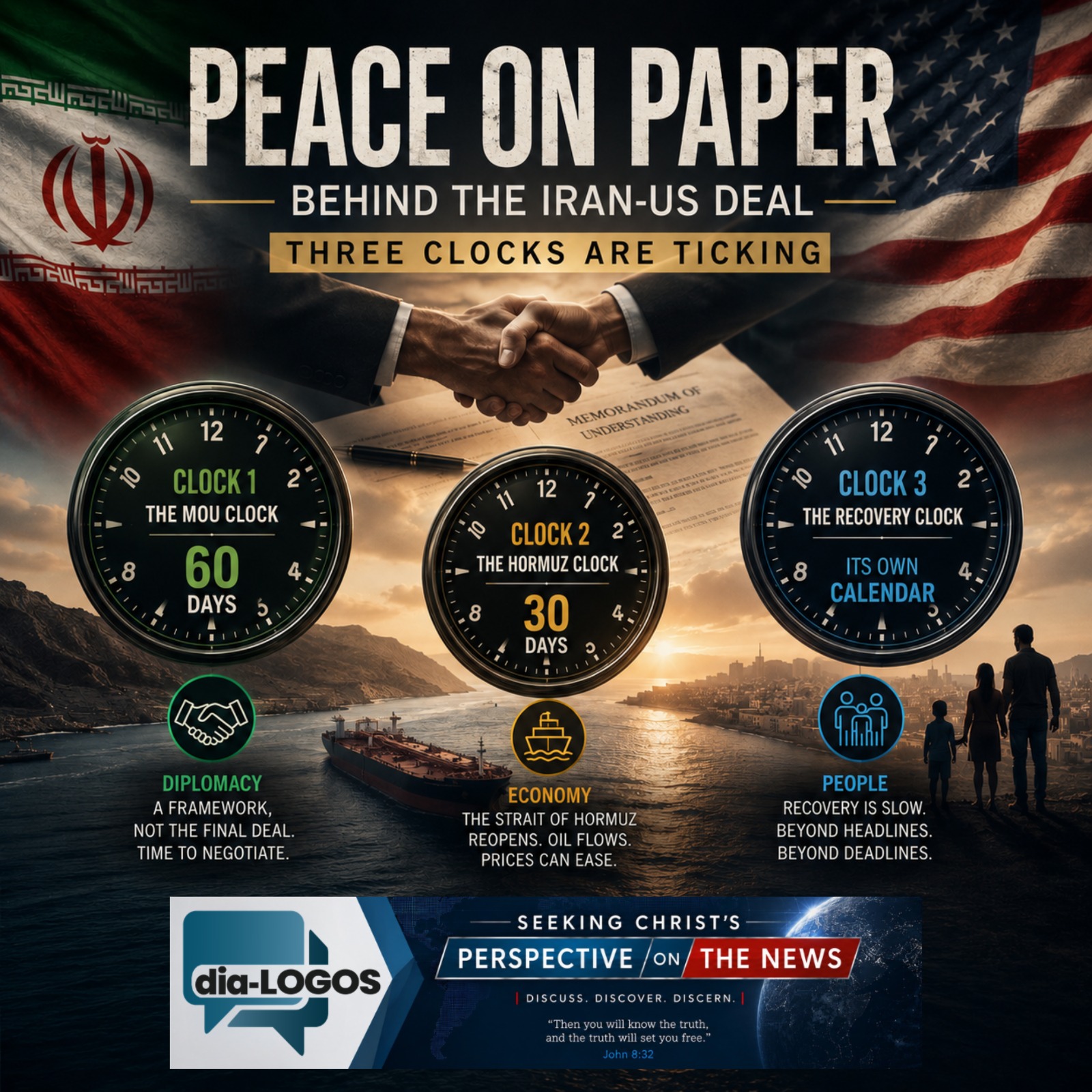

The United States and Iran signed a memorandum of understanding, bringing three months of conflict to a halt, at least for now.
Around the world, there was a collective sense of relief. That's understandable. Any pause in a conflict involving major regional powers is worth welcoming.
But a signed document and a lasting peace are not the same thing. What matters now is what happens next. And to understand that, it helps to think about three different clocks that started running the moment the agreement was signed.
Each measures something different. Each affects ordinary people in different ways. And for South Africans, those effects are much closer to home than many might assume.
This is not a peace treaty. It is an agreement to keep negotiating. That distinction may sound technical, but it is central to understanding what lies ahead.
CLOCK 1: THE MOU CLOCK (60 DAYS)
It is the one attracting the headlines and generating the political statements. After three months of missiles, drones, naval blockades and escalating tensions, two long-standing adversaries have agreed on a framework for further negotiations.
That matters.
In a world where conflicts often continue because neither side wants to appear weak, choosing discussion over escalation is a positive step.
But it is only a step.
The memorandum is a 14-point framework, not a final settlement. It extends the ceasefire for 60 days while negotiators tackle the issues that were intentionally left unresolved.
Those issues are substantial.
Iran's nuclear programme remains contentious. The future of sanctions remains unclear. Questions around Iranian proxy networks across the Middle East remain unanswered. The long-term management and security of the Strait of Hormuz still need agreement.
In other words, the hardest conversations are still ahead.
The memorandum calls for an immediate cessation of hostilities, including operations linked to Lebanon. It commits the United States to lifting its naval blockade within 30 days and allows for the release of billions of dollars in frozen Iranian assets during the negotiating period.
It also creates a pathway for Iran to reconnect with parts of the global economy.
What it does not do is solve the deeper issues that brought both countries into conflict.
The distrust between Washington and Tehran was not created in three months, and it will not disappear in sixty days. Decades of competing interests, regional rivalries and unresolved security concerns remain firmly in place.
A framework can stop people shooting at one another.
It cannot, by itself, remove the reasons they wanted to.
Sixty days is a remarkably short period to address problems that have been developing for generations.
CLOCK 2: THE HORMUZ CLOCK (30 DAYS)
It receives less attention than the diplomatic process, but for most people it may prove more important.
The Strait of Hormuz is only 38 kilometres wide at its narrowest point. Most people could not point to it on a map. Yet roughly one fifth of the world's crude oil and liquefied natural gas passes through that narrow stretch of water every day.
When Hormuz is disrupted, the effects are felt far beyond the Middle East.
For three months, the Strait effectively became part of the conflict.
Under the memorandum, the blockade is expected to be lifted within 30 days. Shipping routes can normalise. Oil can move more freely. Supply chains that were delayed, rerouted or made more expensive can begin to stabilise.
That is genuinely encouraging news.
However, South Africa enters this period of potential relief with a vulnerability that existed long before the first missile was launched.
The country has become increasingly dependent on imported petroleum products. Before the conflict began, South Africa was already importing around 61% of its fuel requirements, compared with roughly 22% just four years earlier.
The gradual closure of domestic refineries has left the country more exposed to international disruptions than at any point in recent history.
The war did not create that weakness.
It exposed it.
That means the reopening of Hormuz should not be mistaken for a solution. It reduces one source of pressure, but the underlying vulnerability remains unchanged.
For South Africa, the bigger question is not whether Hormuz reopens. It is whether anything meaningful will be done to strengthen long-term energy resilience.
At the moment, there is no clear timetable for that conversation.
CLOCK 3: THE RECOVERY CLOCK
It is also the slowest.
Diplomats work with deadlines. Markets react in real time. Households operate differently.
One of the realities of economics is that prices tend to rise quickly during periods of instability, but they rarely fall at the same speed once stability returns.
When war breaks out, oil prices react immediately. Currencies weaken. Markets become nervous. Inflationary pressure builds almost overnight.
Peace works differently.
The announcement of a ceasefire does not automatically lower fuel prices. Grocery bills do not shrink because negotiators reach an agreement. Household budgets stretched over months of rising costs do not suddenly recover because officials signed documents.
Recovery takes time. Sometimes weeks. Sometimes months.
And sometimes the economic damage becomes embedded so deeply that life never quite returns to what it was before.
For the past three months, South Africans have absorbed costs generated by a conflict they neither started nor controlled. Those costs showed up in fuel tanks, supermarket trolleys and monthly budgets.
The impact was immediate.
Any recovery will be slower.
Even if oil prices stabilise, there remains a long chain between global markets and local consumers. Refining costs, transportation, exchange rates, taxes and retail pricing all play a role.
Every link in that chain moves at its own pace.
That is why geopolitical progress and household recovery rarely arrive together.
The memorandum has a sixty-day timeline. Hormuz has a thirty-day timeline.
The recovery experienced by ordinary families follows neither.
BEYOND THE CLOCKS
But there is another question that deserves attention.
What actually creates lasting peace?
Not simply the absence of fighting. Not a temporary ceasefire.
Not even a carefully negotiated agreement.
History suggests that durable peace requires something deeper than a signed document.
At some point, somebody has to let go of something.
A grievance.
A claim.
An ambition.
A desire to dominate.
Every meaningful peace process eventually reaches that point.
Strategists describe it as a concession.
People of faith often describe it differently.
We call it grace.
South Africans understand this perhaps better than most nations.
In 1994, the world watched Nelson Mandela emerge from twenty-seven years in prison and choose reconciliation over revenge.
No memorandum required that decision.
No framework produced it.
It came from a place deeper than politics.
That experience shapes how many South Africans think about peace today.
The ultimate question surrounding this memorandum is not whether it was signed.
The real question is whether the parties involved are willing to change the attitudes, assumptions and ambitions that brought them into conflict in the first place.
David Livingstone once said, "I will go anywhere, provided it is forward."
This agreement is a step forward.
It may be fragile.
it may be temporary.
It may ultimately fail.
But it is still movement in the right direction. And that matters.
Yet moving forward is not the same as arriving. A durable peace, regional stability and a settlement that lasts longer than the next negotiating cycle will require more than signatures and deadlines.
It will require transformation.
The prophet Zechariah captured that truth centuries ago when he wrote: "Not by might, nor by power, but by My Spirit, says the Lord."
The first three clocks measure diplomacy, economics and recovery.
There is a fourth clock that no government can control.
It measures the slow work of changing hearts.
That process rarely happens on a sixty-day schedule.
But history shows that it can happen.
South Africa remains one of the strongest examples of that reality.
So while there are good reasons to remain cautious, there are also reasons to remain hopeful.
Not because the work is finished.
Not because peace is guaranteed.
But because conversation has replaced confrontation, at least for now.
And whenever that happens, there is still the possibility that things can turn out better than expected.
In a world that often celebrates power, choose grace.
It remains the harder path.
And very often, the better one.